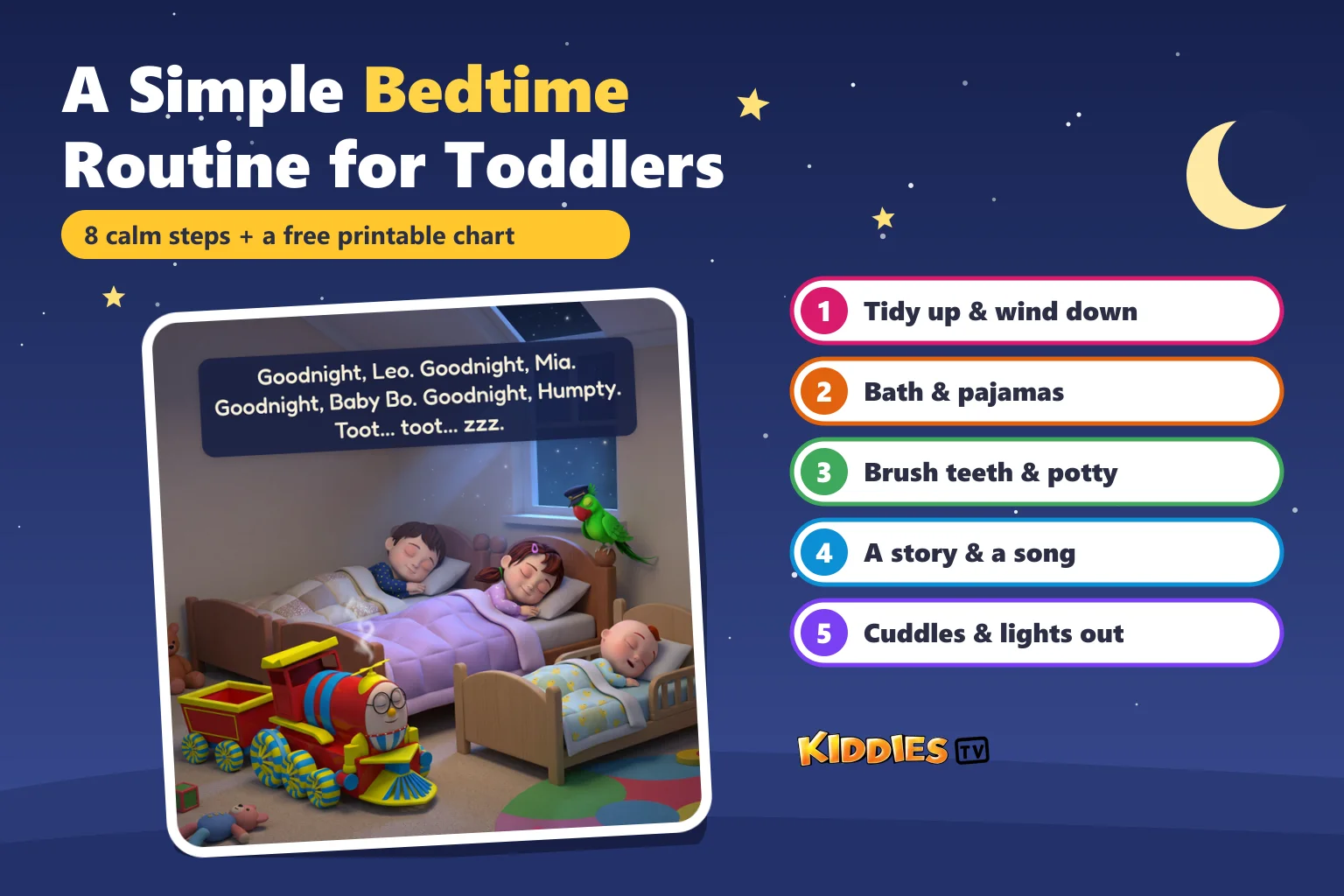
If bedtime in your home feels like a nightly negotiation, you’re in good company. Toddlers are experts at “one more story,” “I need water,” and the great escape from bed. The good news is that one of the simplest tools for calmer nights costs nothing at all: a bedtime routine that happens the same way, in the same order, every night.
Here’s a simple 8-step bedtime routine for toddlers and preschoolers, how much sleep children need at each age, and a free printable bedtime chart your child can follow along with.
In short: start winding down about an hour before bed, then do the same few steps in the same order every night (tidy up, bath, pajamas, teeth, potty, story, cuddles, lights out). Keep it to about 20 to 40 minutes, and say goodnight the same way each time.
Why a bedtime routine helps
Toddlers can’t read a clock, but they’re brilliant at noticing patterns. When bath always comes before pajamas, and pajamas always come before a story, each step becomes a signal that sleep is on the way. Your child knows what’s next, so there’s less to argue about.
A routine also gives everyone a calm stretch at the end of a busy day, and the story and cuddles at the end are often the best part of it. Many parents find that once the routine is in place, the whole evening runs more smoothly.
How much sleep does my toddler need?
The American Academy of Sleep Medicine, in guidelines endorsed by the American Academy of Pediatrics, recommends these amounts of sleep in every 24 hours, counting naps:
- Toddlers, 1 to 2 years: 11 to 14 hours.
- Preschoolers, 3 to 5 years: 10 to 13 hours.
- School-age children, 6 to 12 years: 9 to 12 hours.
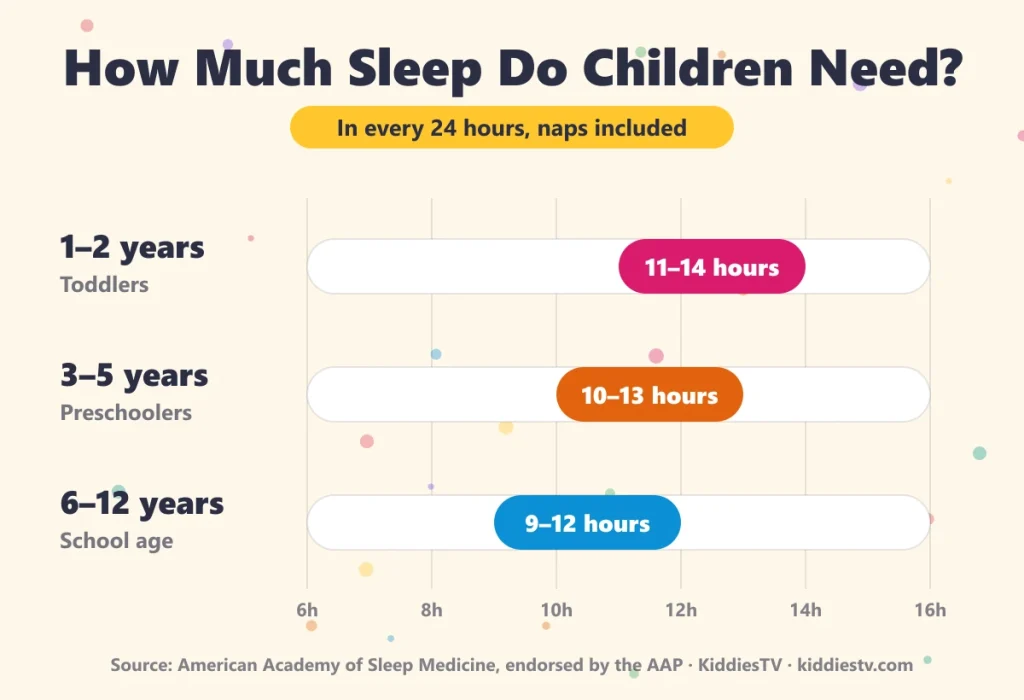
Every child is different, so treat these as a guide. A child who wakes up cheerful and gets through the day without meltdowns is usually getting enough.
A simple bedtime routine in 8 steps
You don’t need to use every step. Pick the ones that fit your family, put them in an order that works, and then keep that order the same every night.
1. Tidy up toys and wind down
About an hour before bed, start slowing things down. Switch off the TV and tablets, dim the lights, and swap rough-and-tumble play for quiet activities like puzzles or coloring. Tidying toys away together is a great first step: it tells your child that playtime is finished for today.
2. Bath time
A warm bath is a lovely way to relax, and splashing about is fun too. It doesn’t have to happen every night. On non-bath nights, a quick wash of hands and face can take its place, so the routine still feels the same.

3. Pajamas on
Toddlers love to feel in charge, so give them a small choice: “Do you want the stars or the dinosaurs tonight?” Two options is plenty. A choice like this gives them a bit of control without opening a big debate.
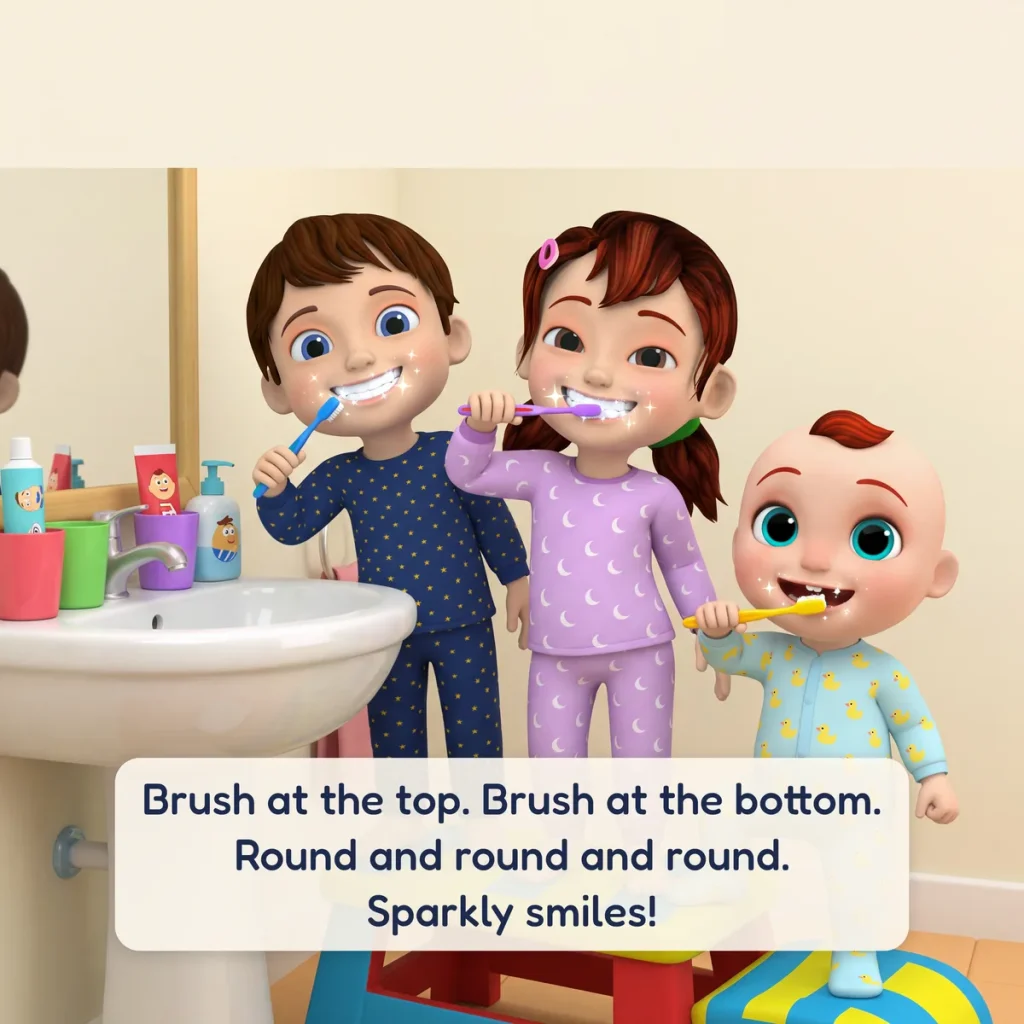
4. Brush teeth
Brush for two minutes, covering the top, the bottom and all the way round. Use a smear of fluoride toothpaste the size of a grain of rice for children under 3, and a pea-sized amount from age 3. Most young children need a grown-up to help, or at least to finish the job.
Try this: brush along to a two-minute song, or let your child brush a teddy’s teeth first.
5. Use the potty
If your child is potty training or newly dry, a last trip to the potty or toilet belongs near the end of the routine. Offering the last big drink a little earlier in the evening can help too.
6. Story time
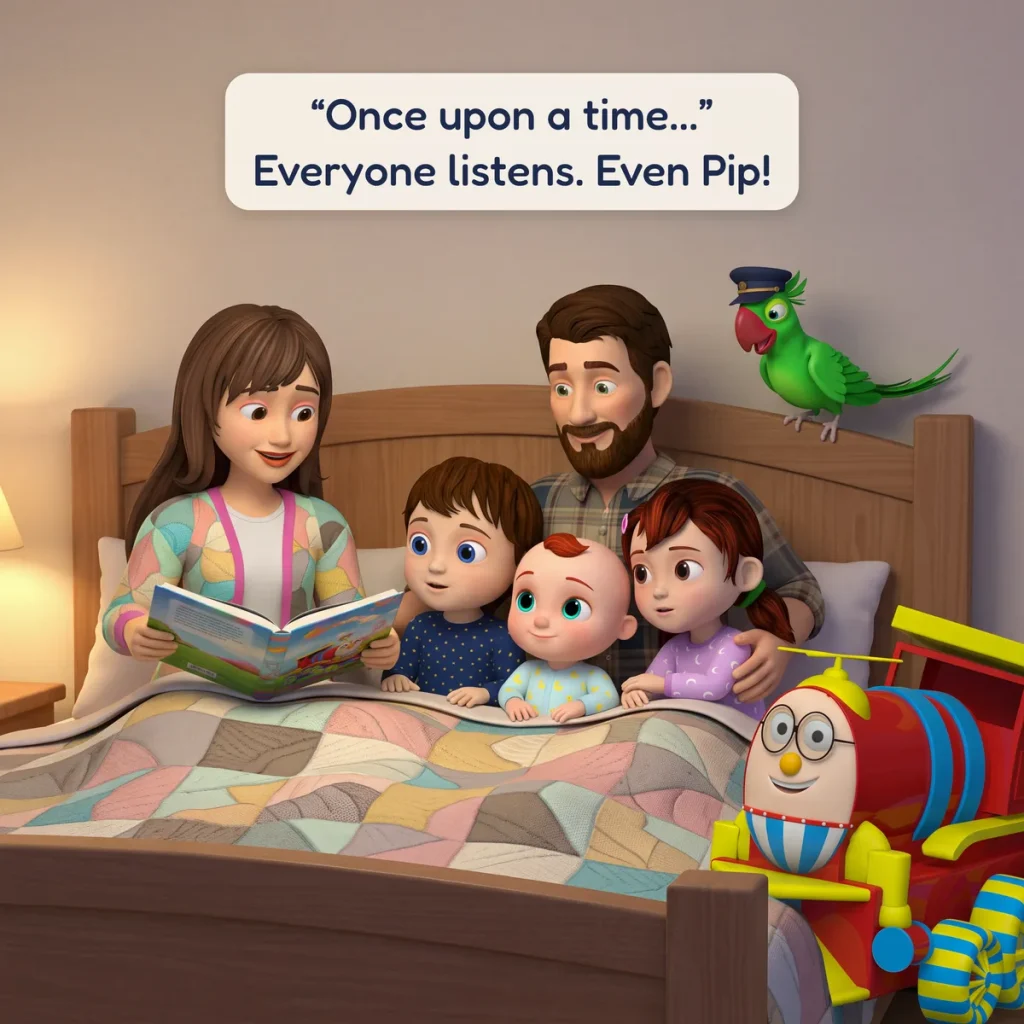
Snuggle up with one, two or three books, and agree how many before you start. Don’t worry if your child picks the same story every night for weeks. Repetition is comforting for little ones, and it builds their language too.
7. A song and cuddles
A quiet song is a gentle bridge between the story and sleep. Lullabies and soft nursery rhymes work beautifully. Our Twinkle, Twinkle, Little Star lyrics page has all the words if you need a reminder. Finish with hugs and kisses.
8. Lights out
Say goodnight the same way every night: the same words, the same kiss, maybe a special goodnight to a favorite teddy. Use a dim night light if your child likes one. Many sleep experts suggest leaving while your child is drowsy but still awake, so they learn to drift off on their own.

Make it visual with a bedtime routine chart
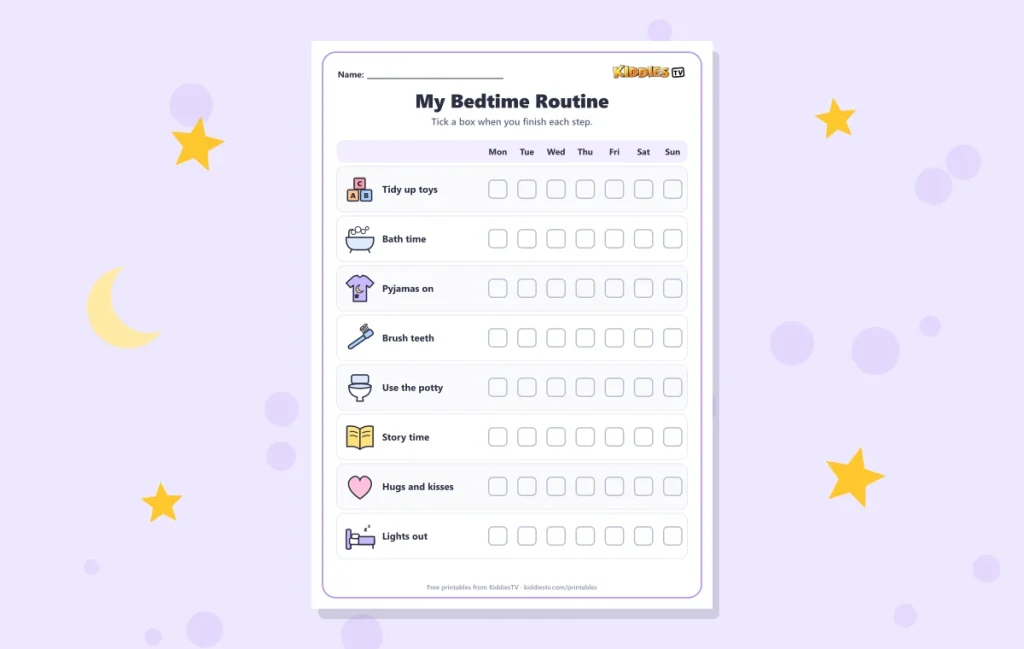
Toddlers can’t read a list, but they can follow pictures. A bedtime routine chart shows every step as a picture, so your child can see what comes next and tick it off when it’s done. That little tick gives them a sense of control, and it means you’re not the one doing all the reminding.
Our free Morning and Bedtime Routine Charts have eight picture steps each, from tidying up toys to lights out, with a tick box for every day of the week. They’re a free PDF in A4 and US Letter size.
Tip: if you’d like to add a reward for a week of smooth bedtimes, our guide on how to use a reward chart explains how to keep it simple and positive.
Turn bedtime into a story
Children love seeing their own routine in a book. Our picture book Humpty’s Bedtime Train follows Leo, Mia and Baby Bo as Humpty the Train chugs along the Bedtime Line: Tidy-Up Town, Bubble Bath Bay, Pajama Junction, Toothbrush Tunnel, Storybook Station, Cuddle Corner and, last of all, Dreamland. A “Next stop!” refrain lets little ones join in, and a map of the Bedtime Line at the back gives them a route to follow every night.
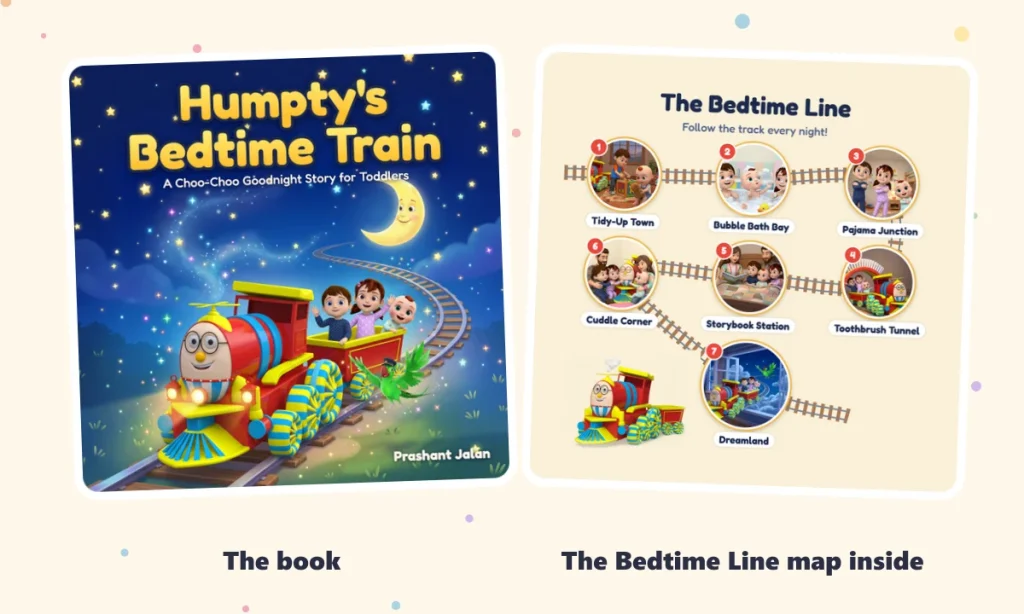
It’s for ages 2 to 5 and is available as a Kindle book and a paperback. If mornings are a struggle too, its companion book, Humpty’s Good Morning Train, does the same for getting up and out of the door.
Common bedtime problems (and what helps)
- Endless “one more” requests. Build the usual ones into the routine: one drink of water and one last hug, then lights out. When the request is already part of the plan, there’s nothing to bargain for.
- Getting out of bed. Walk your child back calmly, with as little chat as possible, as many times as it takes. Staying boring and consistent works better than a big reaction.
- Fear of the dark. A dim night light and a favorite cuddly toy can help. Take the fear seriously, and keep reassurance short and calm.
- The routine keeps growing. If bedtime now takes an hour, trim it back. Stick to the steps that matter most to your child, and agree on limits, like the number of books, ahead of time.
Bedtime routine questions parents ask
What time should my toddler go to bed?
Most toddlers do best with a fairly early bedtime, often somewhere between about 6:30 and 8:00 pm. The right time depends on when your child wakes up and how long they nap. Count back from their usual wake-up time using the sleep amounts above.
How long should a bedtime routine take?
About 20 to 40 minutes is plenty for most families. That’s long enough to feel calm and unhurried, but short enough that your child doesn’t get a second wind.
When should I start a bedtime routine?
It’s never too early or too late. Even babies benefit from a short, simple routine. With toddlers and preschoolers, you can start tonight: explain the new steps during the day, then follow them that evening.
Does the routine have to be exactly the same every night?
The order matters more than the details. If you’re away from home or running late, do a shorter version with the same steps in the same order, like pajamas, teeth, one story and a cuddle. The familiar pattern is what helps.
When should I talk to a doctor about my child’s sleep?
Speak to your pediatrician if your child snores loudly most nights, seems to pause in their breathing during sleep, is very sleepy during the day, or if sleep problems carry on for weeks despite a steady routine.
Sweet dreams
A good bedtime routine doesn’t need to be perfect or long. It just needs to be predictable and warm. Pick a few steps, print the chart, and give it a week or two to settle in. For more calm bedtime songs, browse our nursery rhyme lyrics, and find more free charts and worksheets on our printables page.
Goodnight from all of us at KiddiesTV!
Leave a Reply