Author: amitjalan

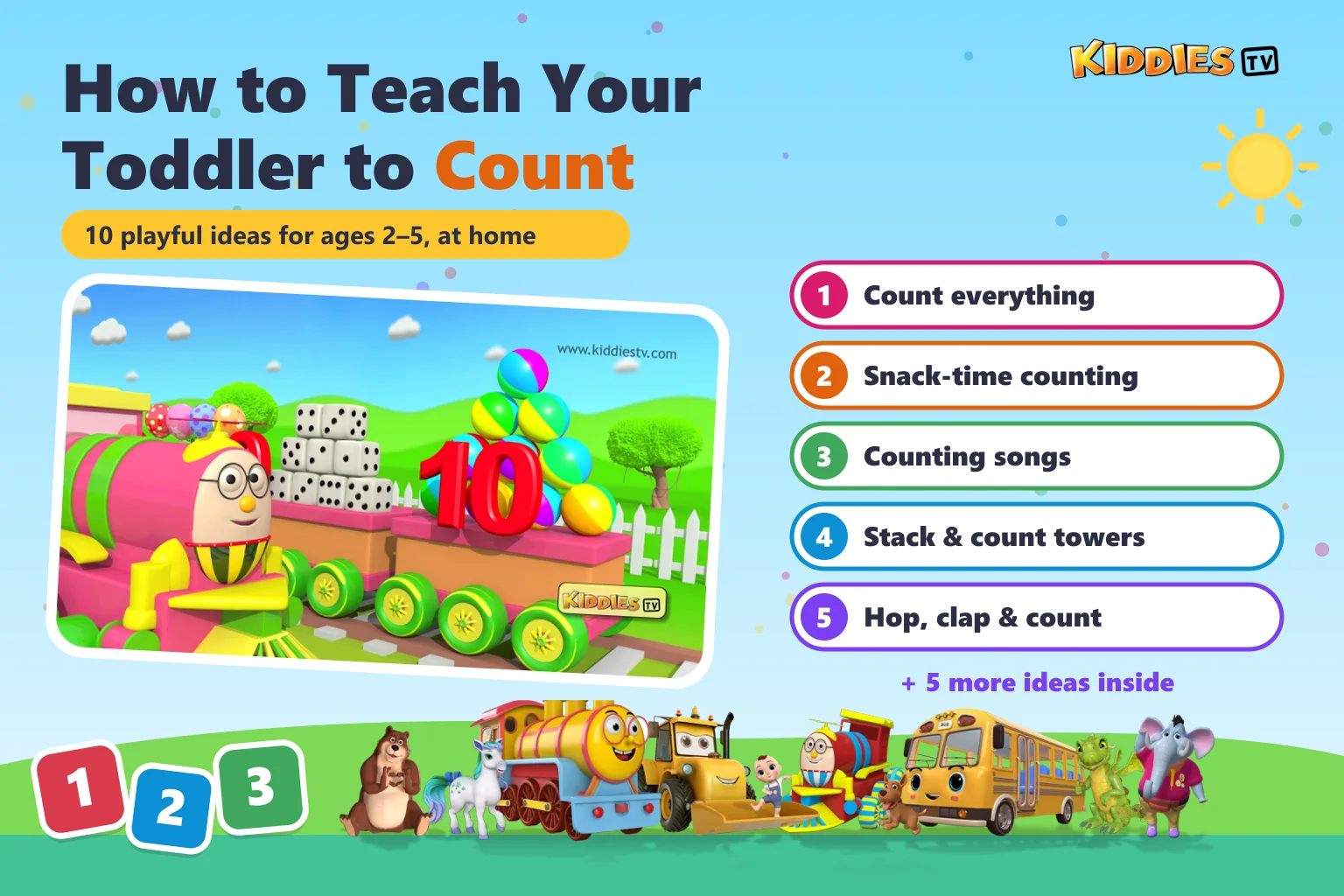
  • How to Teach Your Toddler to Count: 10 Playful Ideas for Ages 2–5

    How to Teach Your Toddler to Count: 10 Playful Ideas for Ages 2–5

    “One, two, three, four, five!” Most toddlers love to chant numbers long before they know what the numbers mean. That’s a great start, but real counting is more than saying words in the right order. Your child also needs to learn that each number goes with one object, and that the last number they say tells them how many there are.

    The good news is that you don’t need worksheets or flash cards to get there. Counting is everywhere: on the stairs, at the breakfast table, in the bath. Here are ten playful ways to turn ordinary moments into counting practice, plus a free printable to try at home.

    A quick word on ages: every child learns at their own pace. Many two-year-olds can say a few numbers in order, many three-year-olds can count a small group of toys, and by four or five many children are counting to ten and beyond. Follow your child’s lead and stop while it’s still fun.

    1. Count everything, and touch as you count

    The single most useful counting habit is also the simplest: count things out loud, all day long, and touch or point to each one as you say its number. Stairs, buttons, socks, spoons, cars on the street. Touching each object helps your child see that every number belongs to one thing, which is the key step from chanting numbers to really counting.

    Try this: line up three or four toys and count them together, guiding your child’s finger from one toy to the next. Then ask, “So how many teddies are there?”

    2. Sing counting songs and rhymes

    Songs make long lists easy to remember, and the number order is exactly that: a list. Classics like “One, Two, Buckle My Shoe”, “Five Little Ducks” and “Ten in the Bed” give children the number words in order, while counting-down songs quietly introduce the idea of taking one away.

    Try this: sing along to a counting video, like our Learn Numbers 1 to 10 with Humpty the Train or Wheels on the Bus Number Race, and hold up a finger for every number you hear.
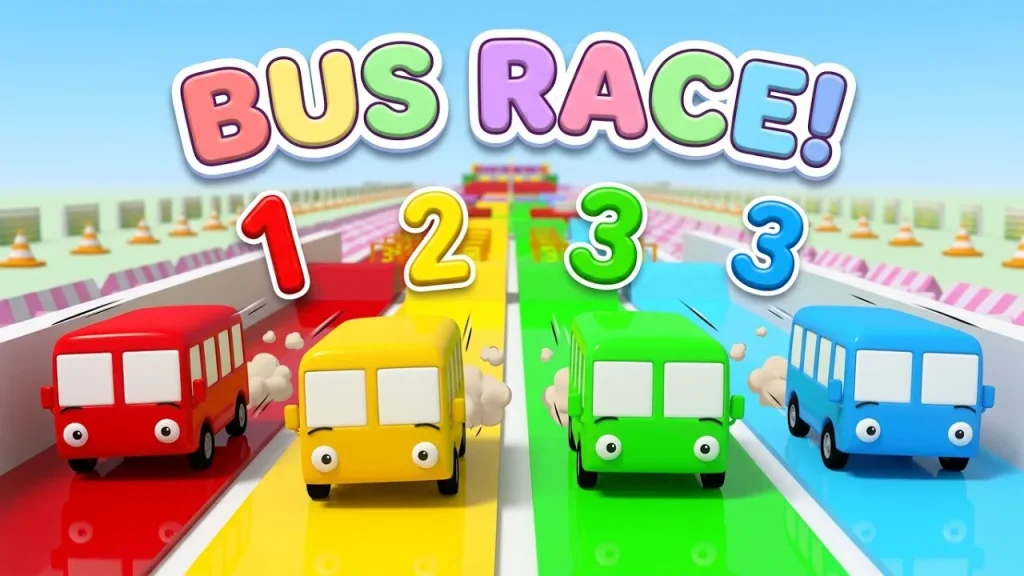
    Colorful number buses lined up for a race in the KiddiesTV video Wheels on the Bus Number Race
    Number buses line up for a race in Wheels on the Bus Number Race on the KiddiesTV YouTube channel.

    3. Let fingers do the counting

    Fingers are a counting tool your child always has with them. Ask “Can you show me three fingers?” or “How old are you? Show me!” Finger rhymes such as “Five Little Monkeys” are perfect here: put one finger down each time a monkey falls off the bed and count how many are left.

    Try this: hold up some fingers and ask your child to copy you, then count both hands together to check.

    4. Make snack time counting time

    Food is the most motivating counting material there is. Count crackers onto a plate, apple slices into a bowl or peas onto a spoon (cut food into toddler-safe pieces, as always). Snacks are also a natural way to meet “more” and “fewer”: who has more pieces of banana, you or teddy?

    Try this: count five crackers together, let your child eat one, then count again. “Now how many are left?” That’s their very first subtraction problem.
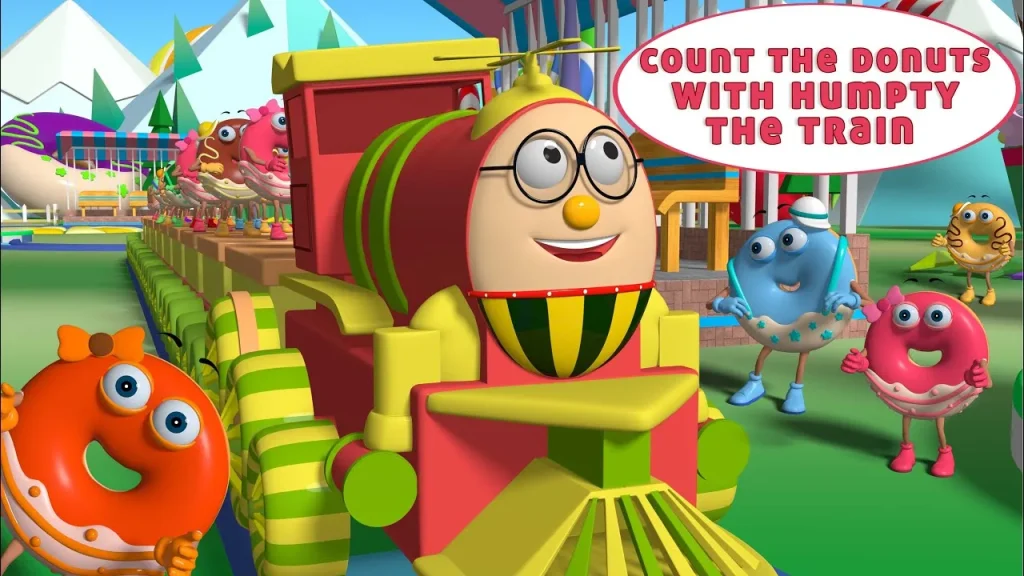
    Humpty the Train carrying donuts to count, from the KiddiesTV video Count the Donuts with Humpty the Train
    Humpty the Train delivers a load of sweet treats to count in Count the Donuts with Humpty the Train.

    5. Go on a number hunt

    Once your child knows a few number words, start spotting the written numbers too. They’re on front doors, buses, clocks, elevator buttons, price tags and cake candles. Hunting for them helps children connect the spoken word “four” with the written 4.

    Try this: on a walk, look for one number at a time. “Can we find a 3 today?” Celebrate every one you find.

    6. Build and count block towers

    Stacking blocks is a ready-made counting game. Count each block as it goes on: “one, two, three…” How tall can the tower get before it falls? Building two towers side by side is a great way to compare: which one is taller, and how many blocks does each have?

    Try this: before the tower comes down, count backwards together: “Five… four… three… two… one… CRASH!” Counting down is fun and builds number sense too.

    7. Hop, jump and clap the numbers

    Toddlers learn with their whole bodies. Count jumps, claps, stomps and spins, or play hopscotch indoors with tape on the floor. Moving to each number keeps the beat steady and helps children feel that every number is one separate step. Our post on playing hopscotch on a rainy day has ideas for setting one up inside.

    Try this: call out a number and do that many jumps together, counting each one out loud.

    8. Play simple board games with dice

    Games where you roll a die and move a counter, such as Snakes and Ladders (or Chutes and Ladders), are brilliant counting practice. Children count the dots, then count the squares as they move. Over time they start to recognize small dot patterns at a glance, without counting each dot, which is an important early math skill.

    Try this: for younger toddlers, use just one die and a short homemade track drawn on paper.

    9. Match numbers to amounts

    The big idea behind counting is that the last number you say tells you how many there are. You can practice it by matching a written number with that many things: put out a card with a 3 and ask your child to place three toy cars next to it. Our free Count & Color printable below does the same thing with crayons: say the number, then color in that many circles, touching each one as you count.
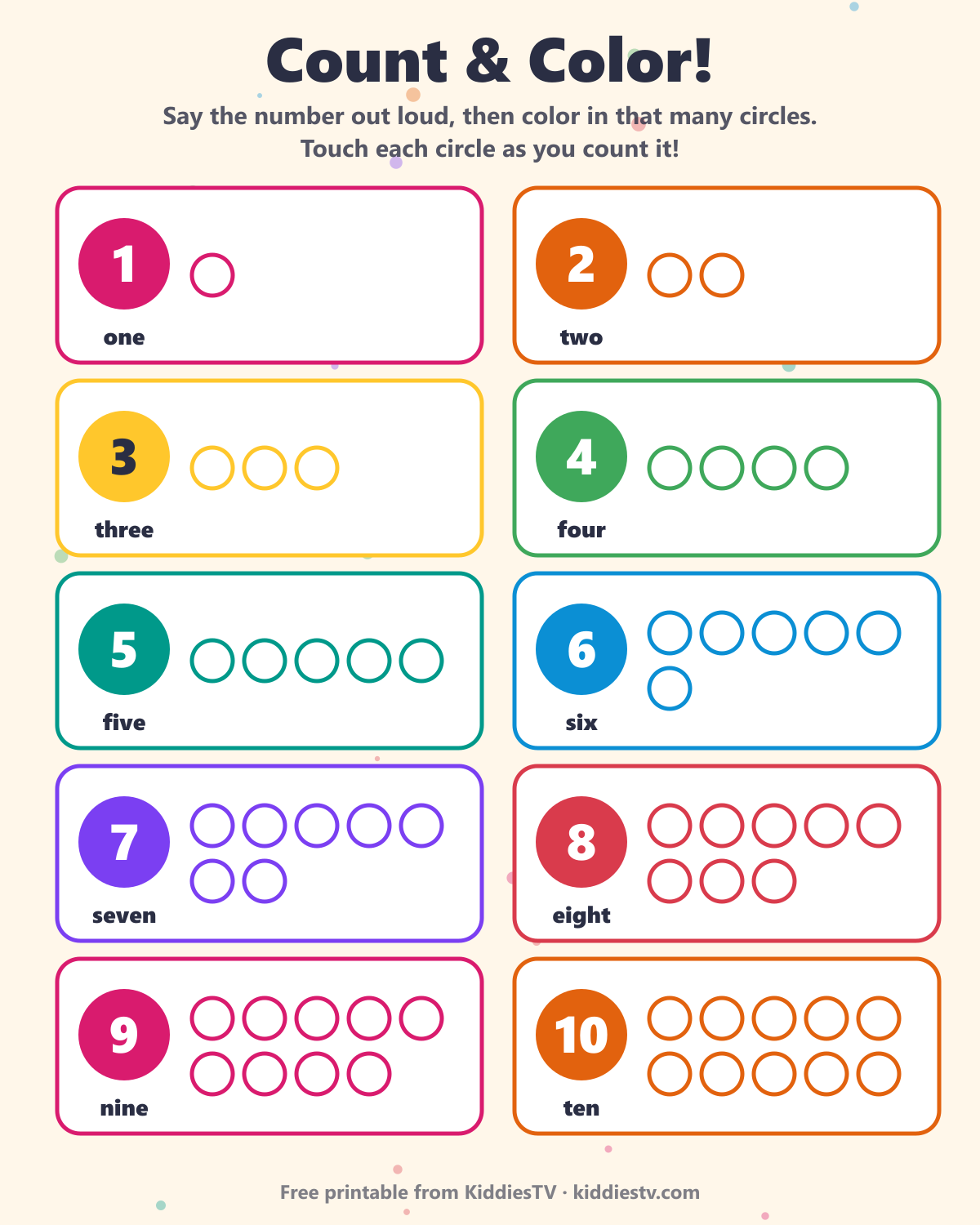
    Free Count and Color printable: number cards 1 to 10, each with that many circles to color in
    Free printable: our Count & Color sheet for numbers 1 to 10. Open the print-quality version, then print it or save it to your phone.

    10. Use a little screen time wisely

    Screens shouldn’t replace counting with you, but a short, well-chosen app can back up what you’re doing together. Look for apps that let children count real objects on screen, hear numbers spoken clearly and trace them, and sit with your child when you can. Health experts such as the American Academy of Pediatrics suggest keeping screen time for 2- to 5-year-olds to around an hour a day of high-quality content, ideally shared with a grown-up.

    In our free Endless 123 Numbers for Kids app, every number from 1 to 50 is its own little planet, with a dancing number character, tracing and a puzzle to finish.
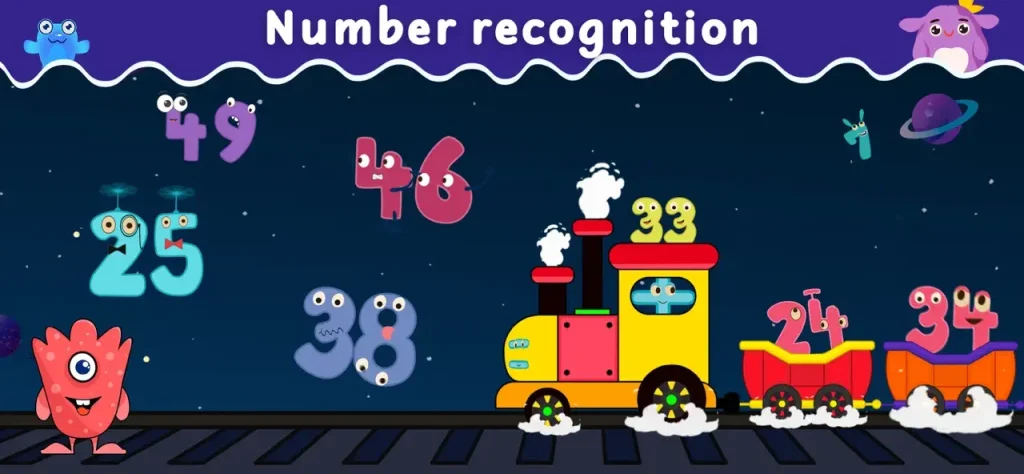
    Number recognition screen in the Endless 123 Numbers for Kids app
    Meeting the numbers in Endless 123 Numbers for Kids.

    When counting feels easy, Maths Monsters: Add & Subtract starts with popping bubbles and counting balloons, then moves on to first sums and a kart race powered by math. For counting to 20 and number tracing, try Numbers 123 Learning Games for Kids. You’ll find all of our free learning apps on the KiddiesTV apps page.
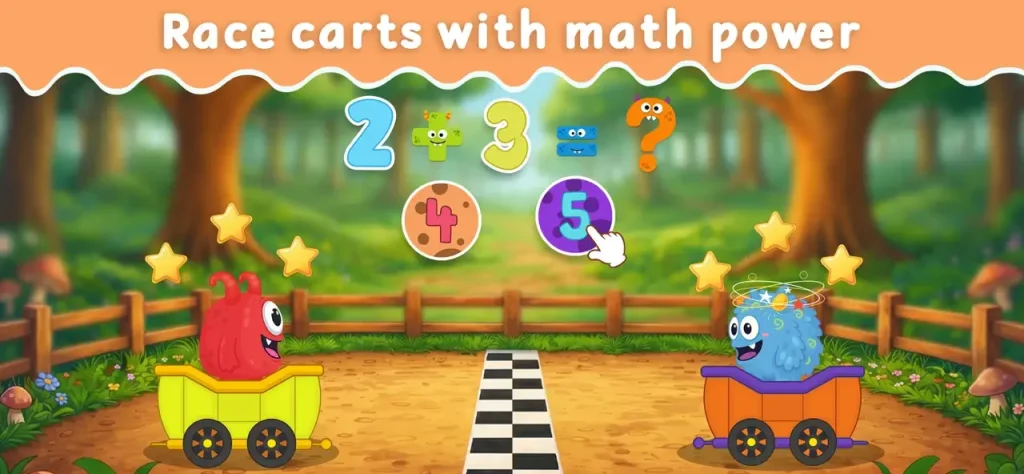
    Monster kart race powered by sums in the Maths Monsters: Add & Subtract app
    Solving sums makes the kart go faster in Maths Monsters: Add & Subtract.

    Put it together: counting moments all day long

    You don’t need to set aside “math time”. Pick two or three of these everyday moments and make counting part of them. A few seconds here and there adds up to a lot of practice by the end of the week.
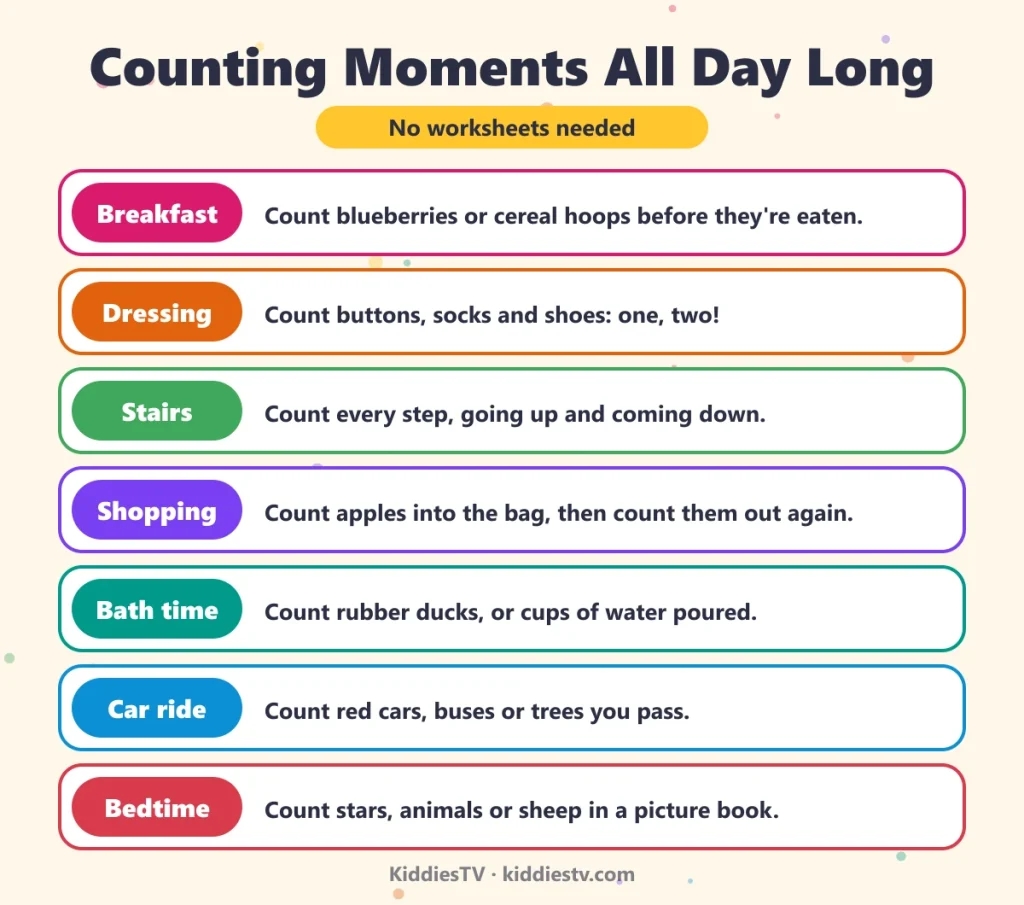
    Chart of everyday counting moments: breakfast, dressing, stairs, shopping, bath time, car rides and bedtime
    Counting moments all day long: no worksheets needed.

    Signs your child is making progress

    • They say the numbers in order, first to five, then to ten, even if they skip one now and then.
    • They touch or point to one object for each number they say.
    • They answer “how many?” with the last number they counted: “One, two, three. Three ducks!”
    • They hold up the right number of fingers when you ask.
    • They spot written numbers when you’re out and about, and can tell which plate has more.

    Questions parents ask

    When should a toddler be able to count to 10?

    There’s no single deadline, and the range is wide. Many children can say the numbers to ten somewhere around age three or four, and count a group of ten objects correctly a little later. Steady, playful practice matters far more than a particular birthday. If you have concerns about your child’s development, your pediatrician is the best person to ask.

    My child can say 1 to 10 but can’t count objects. Is that normal?

    Yes, completely. Reciting numbers is a bit like singing a song from memory, and it usually comes first. Matching one number to each object takes longer to click. Keep counting real things together and touching each one as you go.

    Why does my child skip numbers or say “eleventeen”?

    Because the teens are tricky! Eleven and twelve don’t follow a pattern, and thirteen to nineteen say the ones before the tens, which is backwards from twenty-one onwards. Mix-ups are a normal part of learning. Gently repeat the right number and carry on counting.

    Have fun with it

    Learning to count isn’t a race. The aim is to make numbers feel friendly and useful: something you notice and play with together every day. Pick one or two ideas that suit your child, print the Count & Color sheet, and enjoy those first proud shouts of “Three!”. If your little one is also learning letters, our guide to teaching your toddler the alphabet at home pairs nicely with this one. For more sing-along fun, browse our songs and learning videos.

    Happy counting from all of us at KiddiesTV!
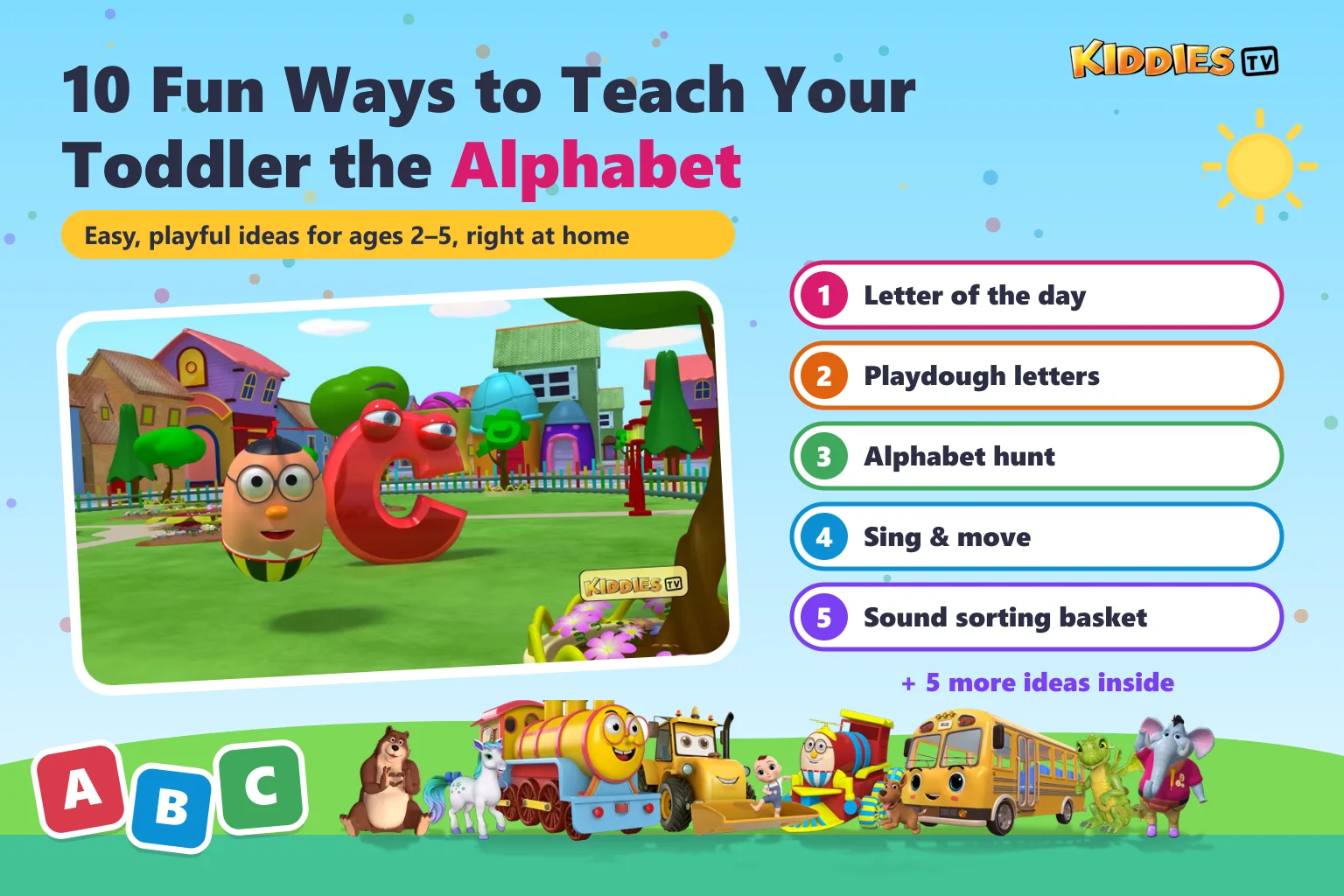
  • 10 Fun Ways to Teach Your Toddler the Alphabet at Home

    10 Fun Ways to Teach Your Toddler the Alphabet at Home

    Long before children can read, they love letters: the big red M on a cereal box, the first letter of their own name, the song they ask for again and again. Toddlers don’t need worksheets or flash-card drills to learn the alphabet. They learn it the way they learn everything else — through play, repetition and lots of chatting with you.

    Here are ten simple, screen-light ways to bring letters into your everyday routine. None of them need special equipment, most take ten minutes or less, and every one can be repeated as your child grows (toddlers love repeating!).

    A quick word on ages: every child is different. Many two-year-olds enjoy singing the ABC song and spotting a few letters; by four or five, many children are starting to link letters to their sounds. Follow your child’s lead and keep it fun — if they lose interest, stop and try again another day.

    1. Start with the letters in their name

    The most exciting letters in the world are the ones in your child’s own name. Write their name in big letters on their bedroom door, their cup or a sheet of paper on the fridge, and point to it often: “That’s M — M for Maya!” Once they know the first letter, add the others one at a time.

    Try this: hide the letters of their name around a room and let them find the letters and line them up in order.

    2. Pick a “letter of the day”

    Choose one letter each morning and keep a lookout for it all day — on food packets, street signs, books and car number plates. Stick a note with that letter on the fridge so you both remember which one you’re hunting for.

    Try this: at dinner, ask “Where did we spot today’s letter?” and count all the places together.

    3. Shape letters with playdough

    Rolling playdough “snakes” and bending them into letters is wonderful for small hands. Children feel the straight lines of an E and the curves of an S, which helps the shapes stick — and it builds the finger strength they’ll need for writing later on.

    Try this: make the first letter of a favorite animal, then make the animal too.

    4. Go on an alphabet hunt

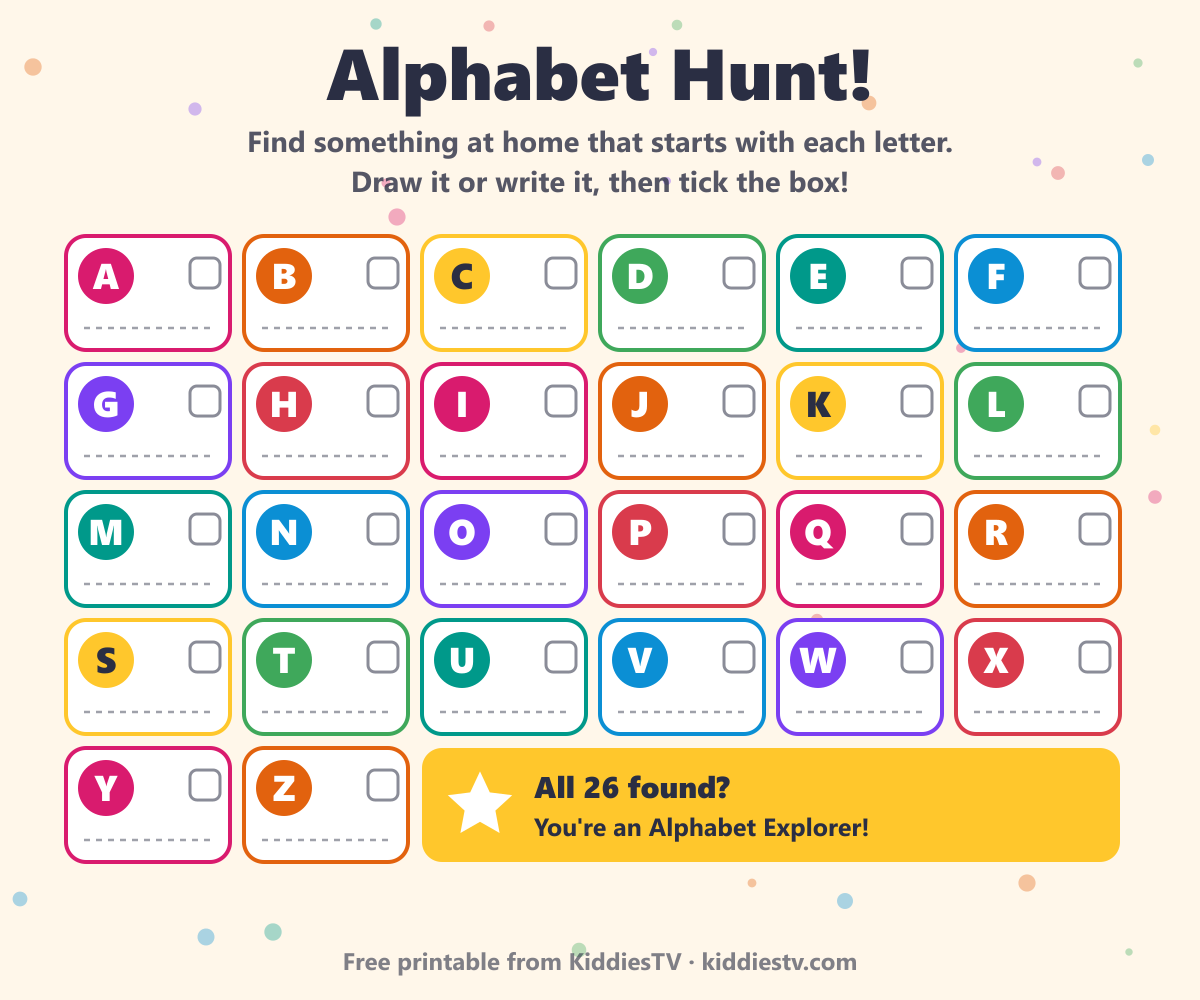
    Turn your home into a treasure map. Can your child find a ball for B, a cup for C, a spoon for S? Use our free printable checklist below: they can draw or write each find and tick the box. Don’t worry about tricky letters like Q, X and Z — hunting for them is half the fun (a queen from a pack of cards or a toy zebra will do nicely).

    Alphabet Hunt printable checklist with a box for every letter from A to Z
    Free printable: our Alphabet Hunt checklist. Open the print-quality version, then print it or save it to your phone.

    5. Sing it, then move it

    The ABC song is a classic for a reason: a tune makes a long list easy to remember. Once your child knows it, slow it down and add a move for each letter — arms up for A, a bounce for B, a clap for C. Singing slowly also helps them hear that “L-M-N-O-P” is really five separate letters, not one long word.

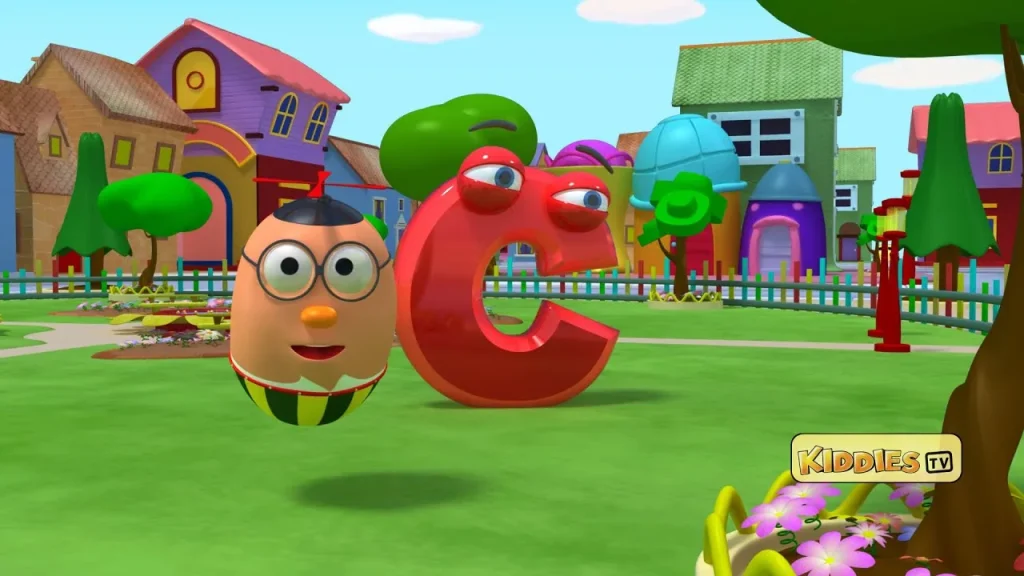
    Try this: watch an alphabet video together, like our Alphabet Adventures with Humpty the Flying Egg, and pause to copy each letter’s shape with your arms and body.

    Humpty the Flying Egg next to a giant red letter C in the KiddiesTV Alphabet Adventures video
    Humpty the Flying Egg meets the letter C in Alphabet Adventures on the KiddiesTV YouTube channel.

    6. Make a sound-sorting basket

    Knowing a letter’s name is one step; knowing the sound it makes is the bigger one for reading. Put a few toys in a basket and sort them by their first sound: “b-b-ball, b-b-bear, b-b-banana.” Say the sound the letter makes, not just its name.

    Try this: start with sounds you can stretch out, like mmm, sss and fff — they’re the easiest for little ears to hear.

    7. Read alphabet books together

    Alphabet picture books are a ready-made letter lesson at bedtime. Run your finger under the big letter, say its sound and chat about the picture. Any book works, though — pausing to spot the first letter of your child’s name on a page is just as valuable.

    Try this: let your child “read” the letters on a favorite page to you.

    8. Write letters with fingers, not just pencils

    Toddlers aren’t ready for neat handwriting, but they love making marks. Let them trace letters in a tray of rice or salt, paint them on a wall outside with a wet brush, chalk them on the pavement or draw them in foam on the bath tiles (stay close to little ones around foam and water). Big movements now make pencil control easier later.

    Try this: write a letter for your child to trace over, then swap — they write one and you trace theirs.

    9. Play letter games in everyday moments

    Car rides, queues and bath time are perfect for quick letter games. “I spy something beginning with b-b-b…”, matching magnetic letters on the fridge, or letter bingo with homemade cards all turn waiting time into learning time.

    Try this: stick foam letters on the bath wall and ask your child to hand you the letter that starts their name.

    10. Use a little screen time wisely

    Screens shouldn’t replace playing with you, but a short, well-chosen app can back up what you’re doing together. Look for apps without scores or timers, with clear letter sounds and tracing — and sit with your child when you can, talking about what they see. Health experts such as the American Academy of Pediatrics suggest keeping screen time for 2- to 5-year-olds to around an hour a day of high-quality content, ideally shared with a grown-up.

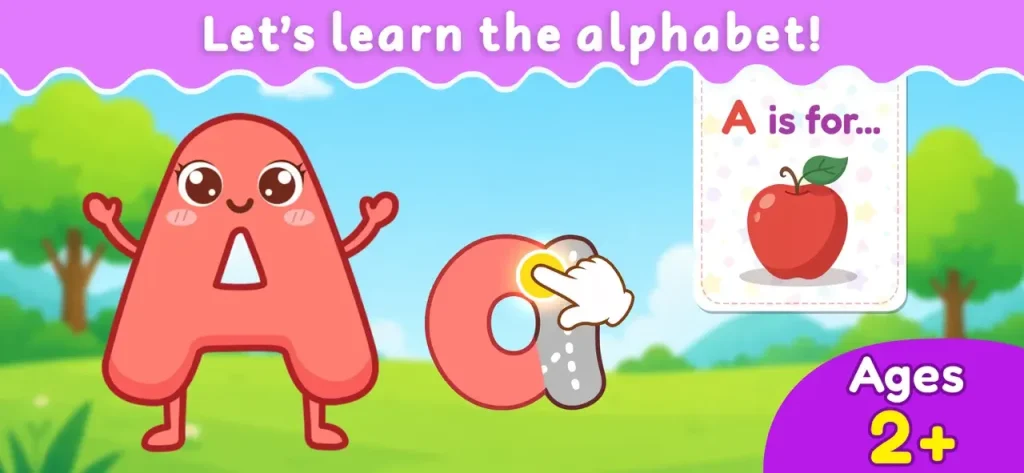
    Our free Endless Alphabet ABC for Kids app gives every letter its own puzzle, word and silly animation, with guided tracing for capital and small letters.

    Endless Alphabet app screen with a smiling letter A, a finger tracing a small a, and an A is for apple card
    Tracing the letter A in Endless Alphabet ABC for Kids.

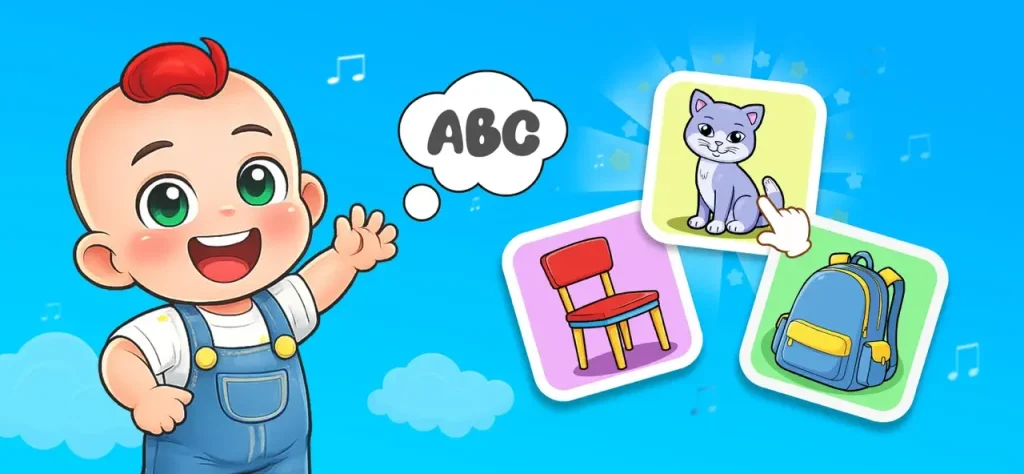
    For the youngest, Baby Flash Cards Sounds Game lets toddlers tap a picture and hear its name spoken clearly — a gentle first step from pictures to words. You’ll find all of our free learning apps on the KiddiesTV apps page.

    Baby Flash Cards app screen: a cartoon baby thinking ABC next to picture cards of a cat, a chair and a backpack
    Tap a picture, hear the word: Baby Flash Cards Sounds Game.

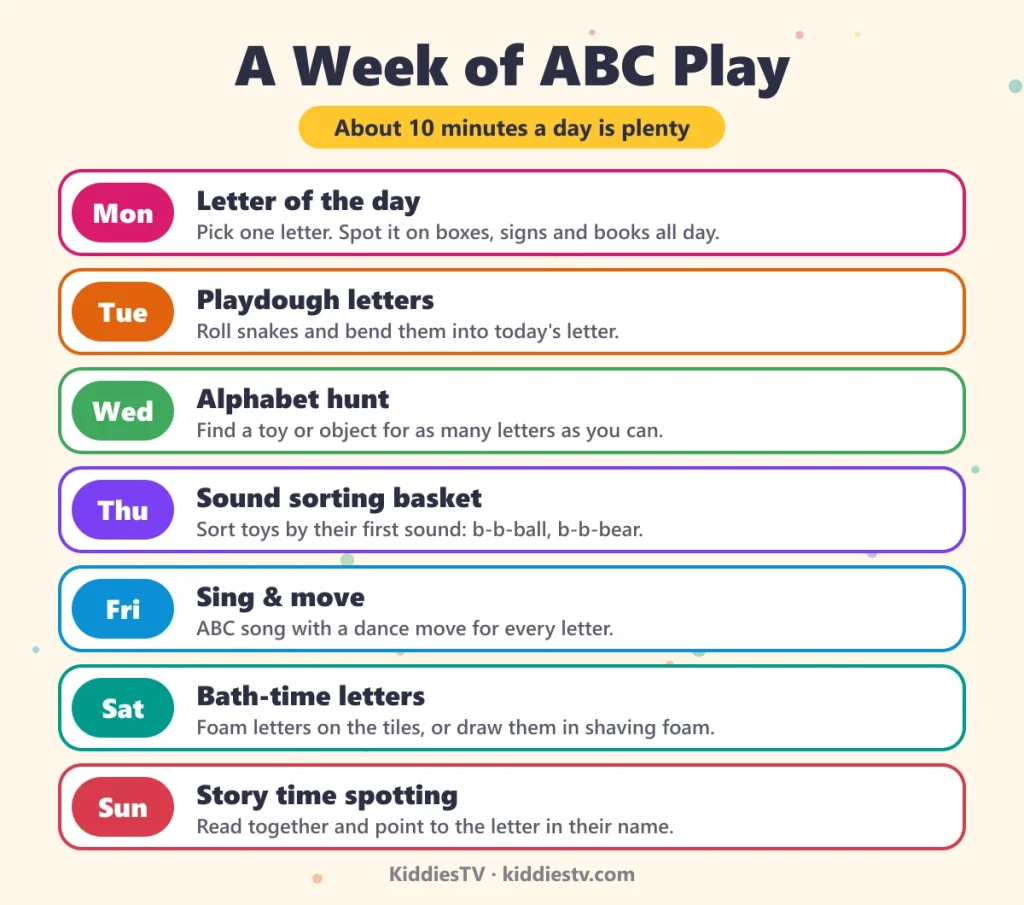
    Put it together: a week of ABC play

    Not sure where to start? Here’s a simple plan that rotates through the ideas above. About ten minutes a day is plenty — little and often works far better than one long session.

    A week of ABC play planner: letter of the day, playdough letters, alphabet hunt, sound sorting, sing and move, bath-time letters and story time spotting
    A week of ABC play: one short activity a day.

    Signs your child is making progress

    • They point out letters they know when you’re out and about.
    • They recognize the first letter of their name — and get excited when they see it.
    • They sing the ABC song, even if a few letters go missing along the way.
    • They start saying letter sounds: “B says b-b-b!”
    • They try writing a letter or two, even back-to-front. That’s completely normal at this age.

    Questions parents ask

    What age should a child know the alphabet?

    There’s no single deadline. Many children start recognizing some letters between two and three and know most of them by around five, but the range is wide. Steady, playful practice matters far more than hitting a milestone by a particular birthday. If you have concerns about your child’s development, your pediatrician is the best person to ask.

    Should I teach capital or small letters first?

    Many parents start with capital letters because their shapes are simpler, then add small letters — the ones children see most in books. Showing both side by side, gently, works well too.

    How long should we practice each day?

    A few minutes at a time is plenty for a toddler. Stop while your child is still enjoying it, so they look forward to next time.

    Have fun with it

    Learning the alphabet isn’t a race. The aim is to make letters feel friendly and familiar — a game you play together, not a test. Pick one or two ideas that suit your child, print the Alphabet Hunt checklist, and enjoy watching those first letters click. For more sing-along fun, browse our songs and learning videos.

    Happy learning from all of us at KiddiesTV!

  • 5 Tips for moms

    5 Tips for moms

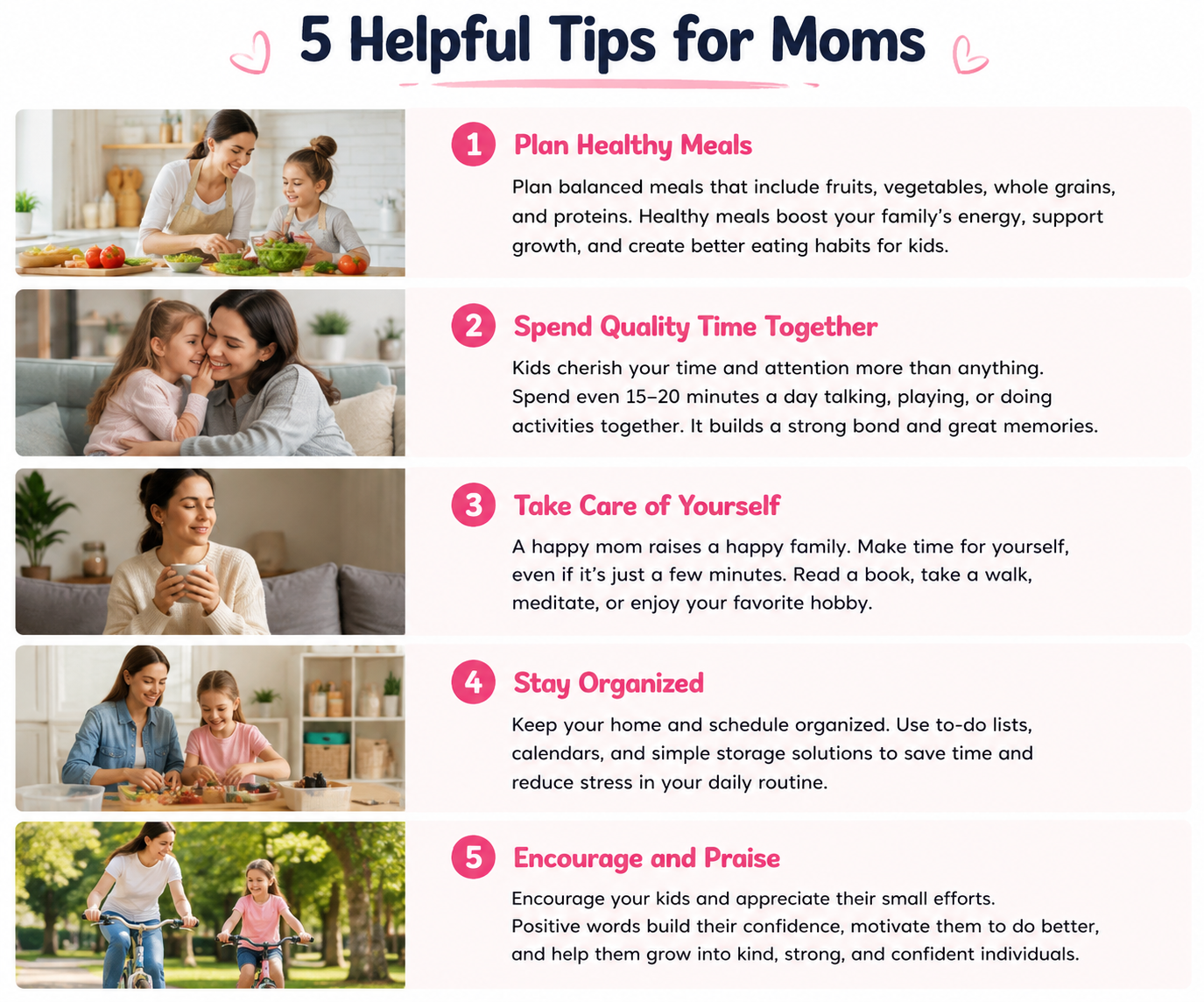
    Discover helpful parenting tips, kids nutrition advice, preschool activities, learning ideas, and everyday inspiration for moms raising young children. KiddiesTV Blog shares simple, practical ideas to help families encourage healthy habits, support early learning, spend quality time together, and raise happy, confident kids.