
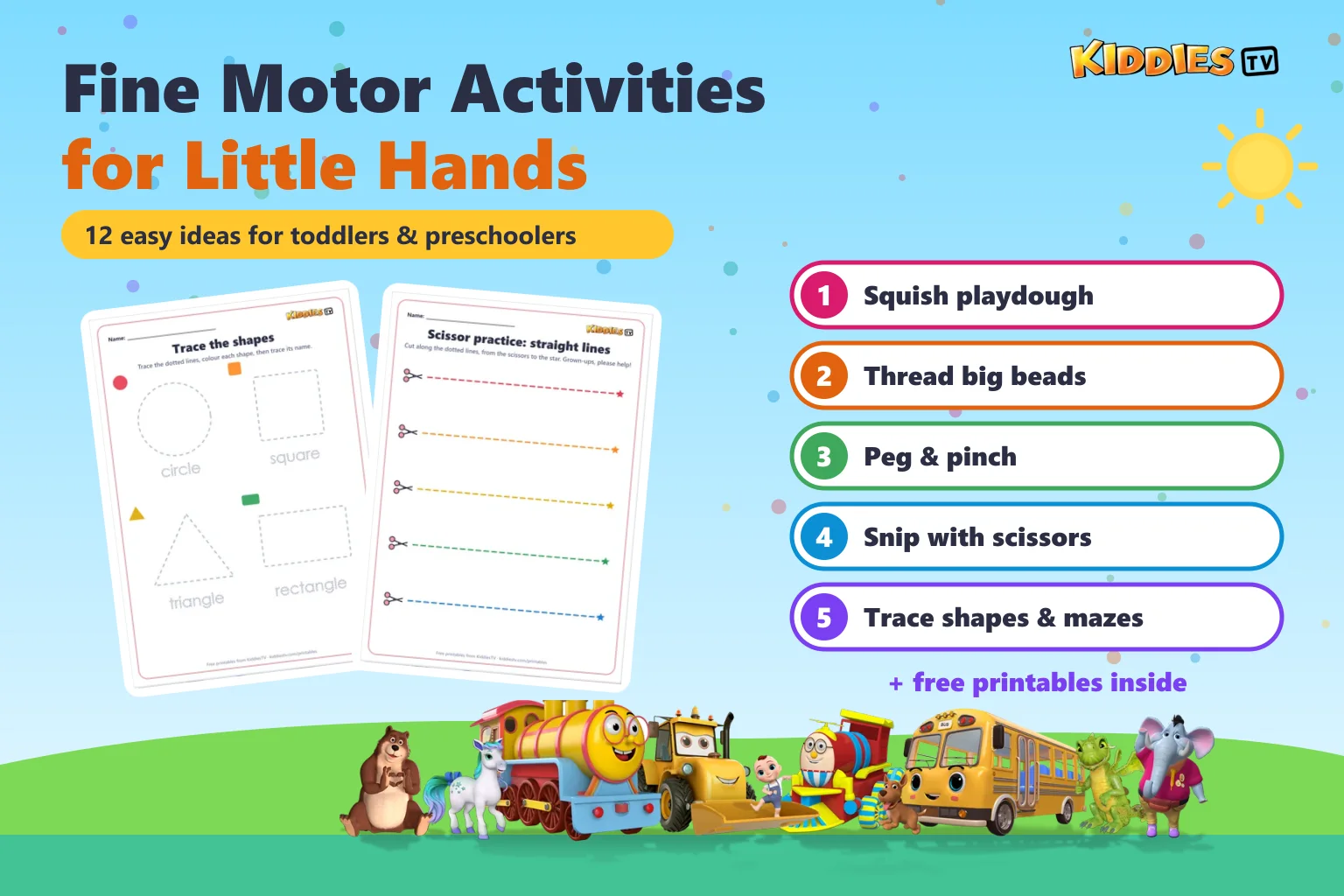

Before a child can write their name, their hands have a lot of quiet work to do. Holding a pencil, doing up a button, snipping with scissors and turning a page all depend on fine motor skills: the small, careful movements of the fingers, hands and wrists.
The good news is that building those skills doesn’t need special equipment or sit-down lessons. It happens through play. Here are 12 easy fine motor activities for toddlers and preschoolers using things you already have at home, plus free printables for when your child is ready for paper and pencil.
In short: squeeze, pinch, thread, snip and scribble. Start with whole-hand play like playdough, move on to finger-and-thumb activities like pegs and stickers, then add scissors and tracing when your child shows interest.
What are fine motor skills, and why do they matter?
Fine motor skills are the small movements we make with our hands and fingers, usually together with our eyes. Children use them all day long: feeding themselves, getting dressed, building, drawing and, later, writing.
Strong hands make school tasks easier too. A child who has spent plenty of time squeezing, pinching and scribbling usually finds it less tiring to hold a pencil and control it. That’s why so many preschool activities look like “just play”: the play is the practice.
Fine motor skills by age
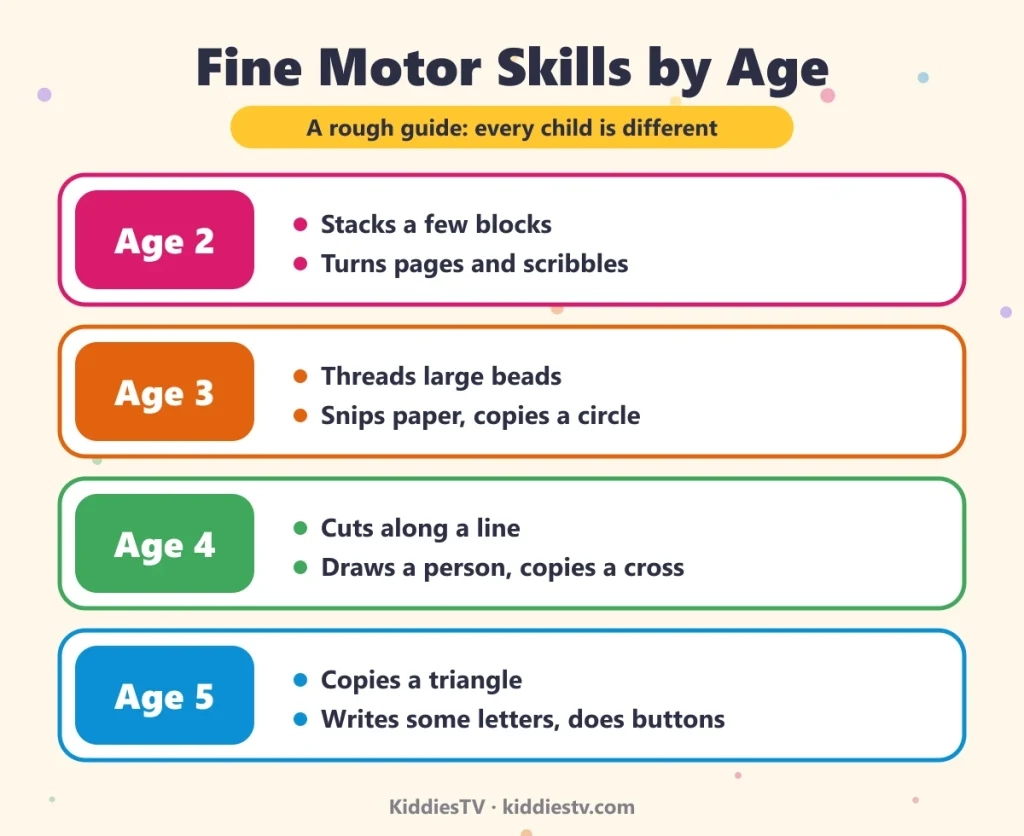
Every child develops at their own pace, so treat these as a rough guide rather than a checklist.
- Around 2 years: stacks a few blocks, turns pages, scribbles, and starts to use a spoon.
- Around 3 years: threads large beads, snips paper with child-safe scissors, and copies a circle.
- Around 4 years: cuts along a line, draws a simple person, and copies a cross.
- Around 5 years: copies a triangle, writes some letters, and manages most buttons.
12 fine motor activities to try at home
A quick safety note: small items like beads, buttons and coins are a choking risk for children under 3, and for any child who still puts things in their mouth. Choose larger pieces and stay close by.
1. Squish and roll playdough
Playdough is the classic hand-strengthener. Rolling snakes, pinching off pieces, flattening pancakes and poking holes all work different muscles. Add a blunt knife or a garlic press for extra squeezing.
2. Tear and scrunch paper
Tearing paper takes two hands working together, which is harder than it looks. Tear old magazines into strips, scrunch tissue paper into balls, and glue the pieces onto a picture.
3. Thread big beads or pasta
Threading penne or large beads onto a shoelace builds the finger-and-thumb grip children later use for a pencil. Tape one end of the lace to the table so the pieces don’t slide straight off.
4. Peg it
Squeezing a clothes peg open is real work for little fingers. Peg socks onto a low line, clip pegs around the edge of a box, or use them as “tweezers” to pick up pom-poms.
5. Peel and place stickers
Peeling a sticker off its sheet is a tiny, precise movement. Draw a line or a simple shape and ask your child to place stickers along it.
6. Post, drop and sort
Cut a slot in the lid of a tub and let your child post large buttons, bottle tops or playing cards through it. Sorting objects into a muffin tray by color works well too.
7. Build and stack
Blocks, interlocking bricks and nesting cups all ask for careful placing and pushing. Start with bigger pieces and move to smaller ones as your child’s control grows.
8. Pour and scoop
In the bath or at the sink, pour water between cups, squeeze sponges and scoop with spoons. Dry rice or lentils in a tray work the same way on a rainy day.
9. Snip with scissors
Start with child-safe scissors and single snips into the edge of a strip of paper, then move on to cutting along straight lines, then curves. Thumb on top is the rule to teach from day one.
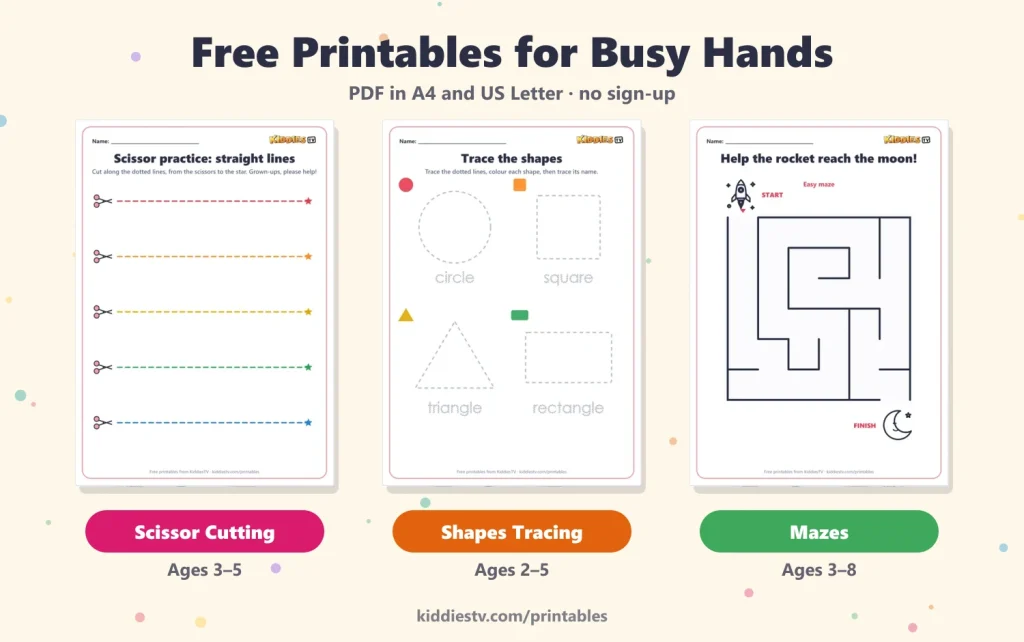
Try this: our free Scissor Cutting Practice Sheets are made for ages 3 to 5.
10. Draw, scribble and color
Give your child chunky crayons, chalk or washable markers and plenty of paper. Scribbling is the first step towards drawing shapes and, later, letters. Short, broken crayons are useful: they’re easier to hold with the fingertips than with a fist.
Our free coloring pages have big, simple pictures for little hands.
11. Trace lines, shapes and mazes
Once your child enjoys drawing, tracing helps them control where the pencil goes. Start with lines and shapes before letters. Mazes are tracing in disguise: your child has to steer the pencil between two walls.
- Shapes Tracing Worksheets (ages 2 to 5)
- Mazes for Kids (ages 3 to 8)
- Alphabet Tracing Worksheets and Number Tracing Worksheets (ages 3 to 6)
12. Help in the kitchen and with getting dressed
Everyday jobs are full of fine motor practice. Stirring, spreading butter, peeling a banana or a mandarin, doing up zips and buttons, and putting on socks all count. They take longer with a small helper, but the practice is worth it.
From scribbles to letters
Children usually learn to draw shapes in a similar order, and those shapes are the building blocks of letters. Ages vary a lot from child to child, but the order tends to be: up-and-down lines, side-to-side lines, circles, a cross, a square and then a triangle.
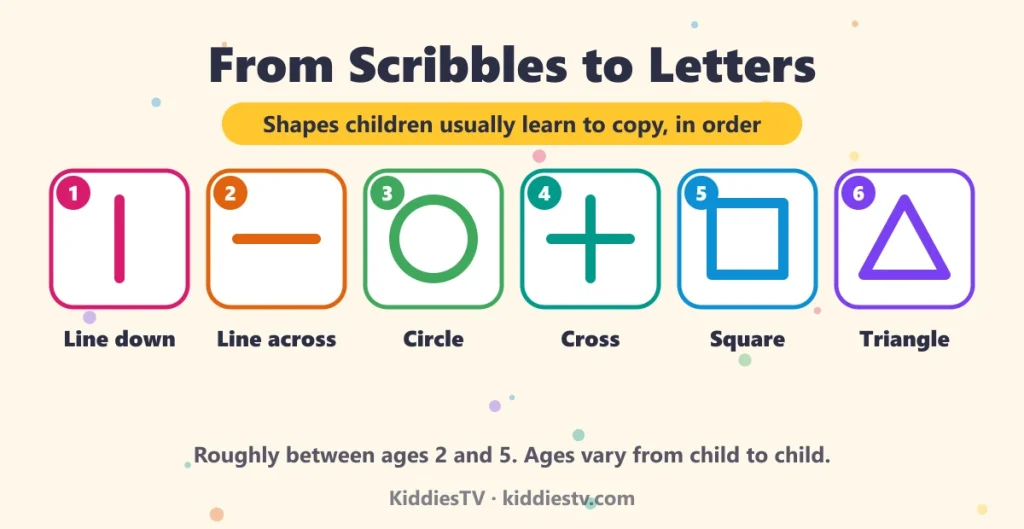
That’s why there’s no rush to start with letters. A child who can draw lines, circles and crosses with confidence has already practiced most of the strokes the alphabet needs. If your little one is at that stage, our guide to teaching your toddler the alphabet at home has plenty of playful ideas.
Can screens help?
Hands-on play does the most for fine motor skills, so it should come first. A little well-chosen screen time can add some extra practice, though. Tapping a small target, and dragging a shape to the right place, both take careful finger control.
In our free online games, children draw and color with a finger in Draw & Colour and drag shapes into their holes in Shape Sorter. Both work in the browser on a phone, tablet or computer.
Fine motor questions parents ask
How can I improve my child’s pencil grip?
Build hand strength first with playdough, pegs and threading, and don’t worry about the grip too early. Many young children start with a fist grip and move to a finger grip between about 3 and 5. Short crayons and small pieces of chalk naturally encourage a fingertip grip.
When can children start using scissors?
Many children can make single snips with child-safe scissors at around 2½ to 3, with an adult right beside them. Cutting along a line usually comes at around 4.
My child isn’t interested in drawing. What can I do?
Take the pressure off paper and pencil. Try chalk on the pavement, a paintbrush and water on a wall, drawing in a tray of flour or sand, or finger painting. The hand movements are the same, and a new material often does the trick.
What’s the difference between fine and gross motor skills?
Fine motor skills use the small muscles of the hands and fingers. Gross motor skills use the big muscles for running, jumping, climbing and throwing. Children need both, and plenty of active play helps with fine motor control too, because a steady body gives the hands a stable base.
When should I ask for advice?
If your child seems to find hand tasks much harder than other children of the same age, avoids them altogether, or loses skills they once had, talk to your pediatrician. They can check how things are going and refer you to an occupational therapist if needed.
Little hands, big skills
A few minutes of squeezing, snipping and scribbling each day adds up. Follow your child’s interests, keep it playful, and bring out the printables when they ask for “real work.” You’ll find all our free worksheets and activity sheets on the printables page, and more play ideas in our guide to teaching your toddler to count.
Happy playing from all of us at KiddiesTV!